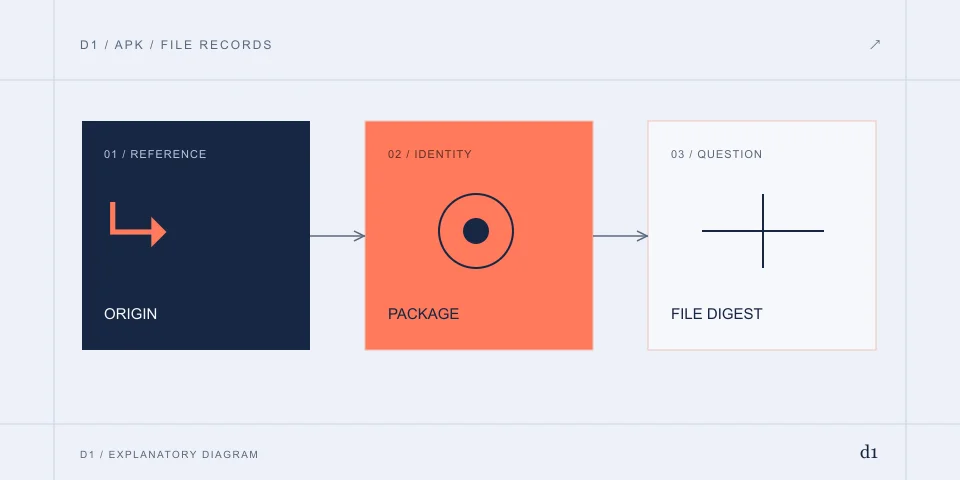
The record at a glance
- Catalogue category
- General
- Developer named by source
- APK Mirror Team
- Source-listed version
- 1.0
- Source-listed size
- 19.74 MB
- Artifact relation
- Standard/Sports container
The catalogue record and its attribution
The dated catalogue attributes Come APK App to APK Mirror Team and displays 1.0 at 19.74 MB. These are source fields, not a company identity authenticated by D1. The listing is one editorial entry in a larger collection; it does not establish a separately implemented Android product for every title.
Three source lines, three package identities
The 13 November source record at comecomeapk.app lists Game 1.0.2 and an earlier website wrapper 3.11.0. The older COME catalogue Standard record belongs to comeapk.dev. Keep the source and package beside each number; this is not one release sequence. These are retained source facts, not new installation or signing tests performed by D1.
| Source line | Package | Version / scope |
|---|---|---|
| comeapk.dev Standard | com.come.sports | 1.0; historical 30–31 October observation |
| comecomeapk.app Game | com.khtybugazu109.com | 1.0.2; separate Game wrapper |
| comecomeapk.app website wrapper | com.comeapk.app | 3.11.0; separate earlier website container |
For source-listed download routes and version context, use the COME and Dream11App release desk
Use the manifest as a map of distinct artifacts
The main COME record is the right place to separate Standard/Sports, Game and legacy test-labelled material. These names refer to different objects or source descriptions. Their version strings cannot be placed in one universal latest-version ranking.
A practical comparison to keep on record
A reader compares Standard 1.0 with Game 1.0.2 and concludes Standard is outdated. Package and signer show why that comparison fails: they are different Android identities. First choose the desired artifact, then compare releases within it.
Route the question through the platform manifest
The retained source describes fourteen platform rows. Visible examples include Standard Android, tablet, Lite and an iPhone/iPad web installation. Separate packages, architecture requirements and formats need their own release expectations. The measured Standard row cannot authenticate the tablet or Lite row just because they appear on the same page. Nor does the count of advertised rows prove fourteen tested working applications.
- Choose Android, Apple web installation or a particular desktop format.
- Identify that row’s package, item or architecture requirements.
- Apply only the release reference belonging to that row.
- Move account and host questions to the service that actually receives them.
Know what the packaged website establishes
The historical Standard inventory contains 419 public files, including 154 HTML pages and forty catalogue records. Its Capacitor configuration names Come Sports. That supports the description of a website container. It does not show forty independently implemented tools. The reference-copy control displays a value; it is not evidence that a reader’s downloaded file was selected and hashed. Game is a separate wrapper whose static configuration names LUCKX.
iPhone and iPad: identify the website being added
The retained source describes a PWA route for iOS or iPadOS 14 and later: open its website in Safari, use Share, choose Add to Home Screen and confirm. This is the source’s documented web route, not a native iOS Game binary verified by D1. Before adding an icon, check the origin displayed in Safari. A home-screen icon does not authenticate a store seller, establish offline coverage or recover an outside account.
| Format | Identification to retain | What the Android digest cannot establish |
|---|---|---|
| Standard Android | com.come.sports; version code and signer | Tablet, Lite or Game equivalence |
| Game Android | com.khtybugazu109.com; version code and signer | A native game, wallet or paying service |
| Apple web route | Website origin and Safari route | An App Store item or native iOS implementation |
| Desktop card | Operating system, architecture, format and publisher | A working or signed native desktop installer |
A desktop card needs operating-system and architecture fields
For a native desktop claim, identify the exact format and processor architecture before applying an installation instruction. A Windows installer, a macOS package and a Linux package are separate artifacts. An Android APK or browser shortcut supplies no evidence of native compatibility. The source manifest’s breadth can route a question, but D1 has not executed those desktop offers or established signing and notarisation results.
Which Android artifact is being compared?
The Come APK App route needs the exact artifact in this table, rather than a digest borrowed from a similarly named listing. Its file observation belongs to the retained 30–31 October 2026 reference. A reader compares Standard 1. The comparison below establishes a historical file reference; it is not a fresh acquisition or a handset test by D1.
| Field | Value |
|---|---|
| Package | com.come.sports |
| Version | 1.0 / code 1 |
| Byte count | 20,696,772 bytes |
| SHA-256 | 6bf5b47239c4407dfb97d7c49b5639ab1f7b335fb5fff05e0360aa1f11338ccd |
| Observation | Reference archive, 30–31 October 2026 |
Installation, iPhone and computer questions
For Come APK App, the retained Android object declares minimum SDK 24, corresponding to Android 7.0. The target SDK is 36. The signer reference is Android Debug; debuggable=true. Static signing and digest information does not authenticate a legal publisher or certify safe execution. An iPhone needs its own iOS or web distribution; an Android APK cannot meet that format requirement.
- Choose the intended manifest row and retain its origin.
- Compare package, version code, bytes and digest for that object.
- Keep the installed signer and system error for an update question.
- Treat first launch and the receiving service as later checks.
Login, registration and outside accounts
The Come APK App catalogue title does not issue credentials. Reading a source page without an account is a narrower claim than anonymous use of a separate host. For signup, login or recovery, identify the receiving service, its contact and applicable terms. A phone, OTP or KYC request belongs to that service, not to the checksum.
Offline notes, match updates and deadlines
For Come APK App, a cached explanation can remain readable while fixture data becomes old. Keep content publication, package observation and match announcement as three dates. A local reminder does not determine an external cutoff, and an offline file cannot observe a new XI or team sheet.
Version labels need a complete identity
Come APK App has a catalogue value and an associated file reference; they should not be merged into a universal latest version. Compare within the same package and signing relationship. A changed web page can appear inside an unchanged wrapper. An old article date cannot establish that a device upgrade or migration succeeded.
Diagnose the stage that actually failed
For a failed Come APK App attempt, write the last successful step. Download complete but Android rejects it: keep package, system and message. App opens but a page is blocked: keep receiving origin and time. Account refuses a code: keep that stage private. A fresh filename is not a diagnosis.
Permissions and the limit of a file comparison
The historical Come APK App description includes permission claims, but the reference analysis records disagreement with the acquired manifest. Do not treat “no permissions” as a tested verdict. A digest compares bytes; permissions, runtime collection and publisher ownership need additional evidence. No payout, account, handset or model-accuracy test was performed by D1.
Choose by task rather than a similar name
The neighbouring record below examines a related task from another angle. Use it to compare the workflow described for Come APK App, rather than treating two catalogue names as two authenticated native applications.
Q / A
Common questions
Route the question through the platform manifest?
The retained source describes fourteen platform rows.
Which file does this record actually identify?
Standard/Sports container is the associated historical artifact. The release table keeps its package, version and date separate from the catalogue description.
READ THE SOURCE / CHECK THE DATE
Documents & references
Dates below belong to the historical references. The writing date does not represent a new account or file test.
- ComeAPK — Come APK App source record2026-10-30 · comeapk.dev
- ComeAPK — platform manifest2026-10-30 · comeapk.dev
- COME source-listed release page2026-11-13 · comecomeapk.app
D1 is an independent information publisher. Product providers handle their own accounts, files and transactions. How we write →